

Since first appearing in the early 1900s, the Shell logo has moved from a realistic pecten or scallop shell to today’s simplified shape with distinctive colours.
Both the word “Shell” and the pecten symbol may have been suggested to Marcus Samuel and Company (original founders) by another interested party. A certain Mr Graham (of apparent Scottish origins) imported Samuel’s kerosene into India and sold it as “Graham’s Oil.” He became a director of The Shell Transport and Trading Company, and there is some evidence that the Shell emblem was taken from his family coat of arms.
Shell logo shape and form, 1900—1930
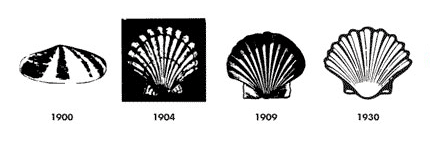
It was around 1915 when the rendering allowed for easier reproduction, shown in the 1930s symbol above.
Colour brought in around 1915

Colour first appeared with the construction of Shell’s first service stations in California. Not only did red and yellow help Shell stand out, but they’re also the colours of Spain, where many early Californian settlers were born. Perhaps by displaying Spanish colours it was hoped an emotional bond would be created.
An alternative idea about the Shell colours was that Mr Graham, the Scottish director, suggested using red and yellow, as they form the basis for the Royal Standard of Scotland.
1948—1971

In the days before fax machines and the internet, many logos included subtle details that would become blurred at small sizes. From the 1950s onwards, the icon became more and more simplified, improving recognition and memorability.
The 1971 logo, which is still used today, was designed by the French-born Raymond Loewy, who also created logos for BP and Exxon.
1995 onwards

The logo has become so recognisable that it often appears without the brand name. This focus on the symbol in isolation can be made when combined with a huge marketing budget — think Nike’s swoosh, McDonalds’ golden arches, Starbucks’ mermaid, Target’s roundel.

Read a little more about the Shell brand, on shell.com.au.
And if you liked this post, you might also like to see the LEGO logo evolution, in the archives.


Comments
David, when I worked for Amoco, I’d drool over Shell’s logo.
Can you imagine what it was like to put Amoco’s logo on promotional materials, geological slides, etc? A nightmare.
en.wikipedia.org/wiki/Amoco
It had ‘DOES NOT REDUCE WELL’ written all over it.
Then BP bought them out. Lucky them, they went from red, white and blue to green and more green. I’m fond of green.
Great article, David. It’s nice to see how logo design has evolved over the years.
Interesting that as the year went on, it became more simplified instead of more complex which so many designers tend to do…
Cat, going for the environmentally friendly fossil fuel link. Never knew you used to work for Amoco.
Jacob, I did. You mentioned Magnetik’s six factors. The six universal attributes of a great mark is a good read on Identityworks.
Jermayn, only those who don’t know any better.
I’ve recently written a article about the new look and feel of shell tankstations http://www.segd.nl/landschap-architectuur/design-case-bewegwijzering-shell.htm what do you think of this change and usage of shell logo?
I believe the pms pantone colors are yellow 116 and red 485.
I’ve posted a scan of the grid the Shell logo seems to be based on: http://nicetype.blogspot.com/2008/04/shell.html
Don’t know if it’s real, or just a mock-up for an ad though.
Thanks!
What I see is that the logo became much more “iconic”. This company has spent billions of dollars to get us to recognize their logo. It has truly become an American Icon.
Mark Lewkowicz
David,
Your comment on the Shell logo, “The logo has become so recognizable that it often appears without the company’s name to identify it.” is a great point. I think the ultimate is to have a design recognized as “This company” without the need for a name. Top of the mind awareness can be a tough mountain to climb.
My professor made this evolution of Shell’s logo to be my homework in biology.
Can someone tell me what color shell yellow was in the early 1930’s, I have a bennett 132 I am restoring and getting sooo many opinions on color codes. Also, does someone have the correct color decals for it? The decals I have now are too light for the “old yellow”! Looking for help. Thanks.
The author seems to be searching for some esoteric explanation for the choice of red and yellow for the Shell logo. When I worked for the Robert Bosch corporation, I was told that the reason they chose red and yellow was very simple – these two colors together are the most visible combination of any colors to make any sign or logo out of. McDonald’s with all their money also came to the same conclusion. I assert without proof that Shell probably did the same.
Thanks, David your post help me a lot with my search for Pantone color of Shell logo for my artwork.
http://www.rafaelmontillaart.com/kubes-in-action-shell-colors/
I worked for Scallop Oil Company in 1982 in the Rockefeller Center, in NYC. 48th St between 5th and 6th. Right near “the Tree”. Scallop was Shell’s parent company if I remember correctly.
Shell Oil’s first oilfield in the United States was about five miles north of Coalinga, California. This field was developed by a British company called California Oilfields Ltd. The community that grew up to support the development was originally called “Balfour” in honor of Arthur Balfour who was Prime Minister of the United Kingdom when the oil camp was founded in 1902. Shortly before WWI it was sold to the Shell trading and transport company. When wells were drilled (and the substrata examined) it was seen that all of the oil wells in this district went through a 300 foot thick deposit of fossilized “pectin” or “scallop” shells (as per the rendering of the 1904 symbol shown above). We in Coalinga have always been taught that “our” fossilized scallop shells were the basis of the Shell Oil Company symbol.
This is the best explanation so far as to the origins of the Shell Logo. Thank you for sharing.
Once my son and I passed by a Shell station and I said, “I love this logo. I wonder what it means.” Then, he said, “It means that their gasoline is pure, like a shell.” He was only 4. Now, I wonder: was he right? Was there a story behind the choice of the shell as a logo?
The Shell logo originated in the Graham family coat of arms, which includes three scallop shells, representing St James and in recognition of pilgrimage to Compostella in Galicia. W & J Graham and it’s related partnerships comprised a significant trading business originating in Glasgow and London in the 18th century with connected partnerships in Bombay, Calcutta, Rangoon, and Karachi as well as the UK and Portugal. The oil distribution business with Samuel was converted into what became known as the “Tank Syndicate,” which was later listed on the London Stock Exchange as Shell Transport & Trading, and Graham’s took a Board seat. The Graham partnerships diminished after WW1 but continued as Graham’s Trading Company with significant textile manufacturing in Portugal and the eponymous port wine shipping business, W & J Graham & Co. The Graham family originated in Stirlingshire in Scotland.
I thought it was Compostella de Santiago in Northern Spain. Santiago refers to St James and the belief his body ended up there. The pilgrimage route started in France and people still walk it.
It’s “Santiago de Compostela”, no “Compostela de Santiago”. And yes, it’s in northern Spain.
I just drove past the sign, and I’m curious as to whether or not the number of those, “ridges” on the shell have any significance.
It has been my understanding that the shell sign of the 50s amd 60s was by Willard Moore. Can anyone shed light?